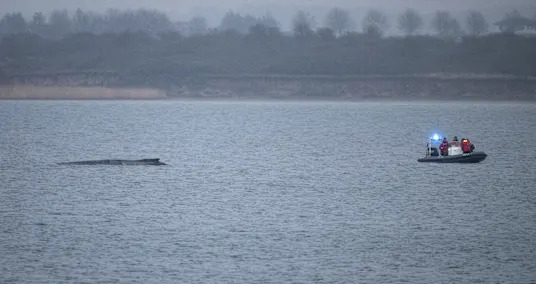
A humpback whale stranded for days off Germany's Baltic coast has gotten stuck on another sandbank, a Greenpeace spokeswoman said on Saturday.
The unlucky animal had garnered media attention for days, after it got stranded on a sandbank off Germany's Timmendorfer Strand resort, near the city of Lübeck, early on Monday.
Days of efforts to free the 12- to 15-metre whale proved unsuccessful until rescuers dug out a channel in the sand around the animal using a floating excavator on Thursday, allowing the whale to swim free the following night.
However, environmentalists and marine experts had feared that the animal could potentially get stuck again, as it was spotted heading back towards shallower water following its release.
Those fears became reality on Saturday, with the whale spotted stranded on a sandbank in the Bay of Wismar, some 40 kilometres to the east of Timmendorfer Strand, according to Greenpeace.
Large whales such as humpback whales are not native to the Baltic Sea. They may follow schools of fish in search of food and end up in the Baltic Sea.
According to experts, underwater noise could also play a role.




 Warning for snow and ice extended
- Tech for Efficiency: Applications and Apparatuses to Accomplish More
- The most effective method to Arrange a Higher Medical caretaker Pay During Your Next New employee screening
- Whale stranded in the Baltic Sea swims free again. It still faces a tough task
- Concern for couple jailed in Tehran as British embassy closes
- 8 Fundamental Stages: Novice's Manual for Secure Your Android with a VPN
- Your kid wants it now. What saying yes, no or not yet teaches kids about money and instant gratification.
- 'Unreal' solar eclipse: Artemis 2 crew just saw one of the rarest sights in spaceflight history
- ‘Raising 10 red flags’: Is Israel’s army exhausted?