When you buy through links on our articles, Future and its syndication partners may earn a commission.

Is it a bird? Is it a plane? No, it's the Hubble Space Telescope transiting the sun at around 17,000 mph (27,000 kph).
Astrophotographer Efrain Morales captured the dramatic footage on Dec. 15, 2025, from the city of Aguadilla in Puerto Rico. In the video, the Hubble Space Telescope appears as a tiny, defined silhouette gliding past the sunspot known as AR4308.
The entire event lasted just 1.01 seconds, leaving Morales no margin for error.
The Hubble Space Telescope orbits at an altitude of about 340 miles (547 kilometers), completing one circuit of Earth every 95 minutes. Catching it against the sun requires not only perfect timing but also precise positioning on the ground.
Transit predictions showed that the alignment was visible within a 4.68-mile-wide (7.54 km) corridor on Earth, meaning that anyone wishing to catch the transit would have to be located at exactly the right place. Even then, the telescope took just 1.01 seconds to traverse the sun from Morales' vantage point — a fleeting encounter that could easily be missed without careful planning and high-speed imaging.
To capture this incredible footage, Morales relied on transit-prediction software to calculate the telescope's exact path across the sun, then paired that timing with a high-frame-rate imaging setup. He recorded the footage using a Lunt LS50THa solar scope, mounted on a CGX-L, alongside an ASI CMOS camera and Cemax 2x Barlows — equipment specifically designed for safe, detailed solar observations where every frame counts. (Reminder: Never observe or photograph the sun without such specialized safety gear.)
Unlike the International Space Station, which frequently steals the spotlight during solar transits thanks to its size, Hubble presents a far greater challenge. Measuring about 43 feet (13 meters) long, the iconic space telescope is roughly 10 times smaller than the ISS, making it much harder to resolve against the sun's brilliant surface.
Editor's note: If you snap an astrophoto and would like to share it with Space.com's readers, send your photo(s), comments, and your name and location to [email protected].
LATEST POSTS
- 1
 Monetary Versatility: Get ready for Life's Unforeseen Difficulties
 - 2Procter & Gamble changes Crest toothpaste packaging to address Texas AG fluoride concerns
- 3What did the gov’t approve for Israel’s 2026 state budget?
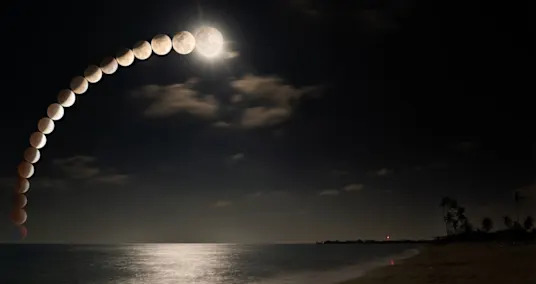
- 4A photographer's journey to capture a blood moon rising over the South China Sea. 'It was an incredible moment'
- 5Former school bus aide pleads guilty to assaulting 3 autistic students in Colorado



- Egypt's cafés and shops forced to close early due to Iran war
- The Ascent of Rousing Pioneers Who Formed History
- Satellite constellations could obscure most space telescope observations by late 2030s: 'That part of the image will be forever lost'
- Polish law aimed at lowering petrol prices takes effect
- Doctor's orders? ‘Belly laugh at least two to five days a week'
- Exploring the Difficulties of Co-Nurturing: Individual Bits of knowledge
- Supportive Tips On Home loans For First-Time Home Purchasers
- Kelsey Grammer on having a new baby at 70: 'You're just more available now'
- Ministry: New German petrol price regulation takes effect on April 1